Address
Abu Dhabi, UAE
Work Hours
Monday to Friday: 10AM - 7PM
Saturday: 10AM - 5PM

Address
Abu Dhabi, UAE
Work Hours
Monday to Friday: 10AM - 7PM
Saturday: 10AM - 5PM

Artificial intelligence is no longer a future concept reserved for innovation labs and speculative strategy decks. It is now being woven into real business operations, from document processing and workflow automation to risk analysis, customer support, and decision support in highly regulated environments. As adoption accelerates, so does the pressure to move quickly. Businesses want the efficiency gains, the improved speed, and the competitive edge. But in the rush to implement AI, one issue keeps surfacing for good reason: trust.
More specifically, can you trust a system if you cannot explain what it did, why it did it, and how the outcome was produced?
That question sits at the centre of what is often called the “black box” problem. The term describes an AI system where information goes in, a result comes out, and the logic in between is effectively hidden from the people relying on it. For low-stakes consumer use cases, that ambiguity may be tolerated. For critical business processes, especially in regulated sectors, it is not.
In those environments, auditability is not an optional enhancement or a nice-to-have governance feature. It is a fundamental requirement. If AI is going to support or influence decisions that affect customers, compliance obligations, legal exposure, or financial outcomes, then the business must be able to account for what happened. It must be able to show the chain of activity, the data involved, the rules applied, the approvals made, and the rationale behind the final result.
This is why the conversation around AI needs to move beyond raw capability and toward operational accountability. The most powerful system is not necessarily the most useful one. In enterprise settings, the useful system is the one that can be trusted, governed, reviewed, and defended.
That is where auditability becomes non-negotiable.
The phrase “black box” has become so common that it can sometimes obscure the real issue. It suggests that AI is inherently mysterious and therefore impossible to govern. That is not quite right. Some underlying model behaviour may be complex, but complexity does not mean businesses are powerless. The real question is not whether every mathematical detail of a model can be explained line by line. The real question is whether the system as deployed in your business is transparent enough to be monitored, reviewed, and audited in practice.
That distinction matters.
Many organisations assume that adopting AI means surrendering visibility. They imagine a trade-off where greater automation requires less control. But that is a false choice. While some generic AI tools do operate with limited transparency, bespoke enterprise solutions can be designed to provide meaningful oversight at every stage. Inputs can be logged. Workflow steps can be tracked. outputs can be versioned. Human review points can be built in. Exceptions can be flagged. Reports can be generated in a format that compliance teams, auditors, and business leaders can actually use.
In other words, the “black box” is not an unavoidable feature of AI. It is often the result of poor implementation choices, weak system design, or a mismatch between consumer-grade tools and enterprise-level requirements.
For businesses in regulated industries, this is an important shift in perspective. The issue is not whether AI is too opaque to use. The issue is whether the chosen solution has been designed with transparency from the start.
When AI is used casually, the consequences of limited visibility may be manageable. If a general-purpose tool helps draft an internal email or summarise a public article, the risk profile is relatively low. But that changes quickly once AI is embedded into core workflows.
If the system is helping review documents, triage cases, classify records, generate compliance-related outputs, or support decisions with regulatory implications, then every result matters more. Errors become more costly. Patterns become more consequential. Oversight becomes more difficult to improvise after the fact.
This is why auditability becomes more important as AI becomes more useful. The closer the technology gets to real operational decisions, the less acceptable it is to treat it like an inscrutable assistant. Businesses need to know what happened, not just hope the answer looks plausible.
They also need to prove it.
That proof may be required by regulators, clients, internal governance teams, insurers, external auditors, or senior leadership. In each case, the same basic question appears in different forms: can you show how this outcome was produced, and can you demonstrate that the process was controlled?
If the answer is no, then the AI may be sophisticated, but it is not enterprise-ready.
The risks created by opaque AI are not theoretical. They are practical, operational, and often cumulative. A system does not need to fail catastrophically to create serious business exposure. Sometimes the greater danger lies in a steady accumulation of uncertainty, where teams rely on outputs they cannot fully validate and cannot easily investigate later.
For regulated businesses, compliance is often the most immediate concern. Legal and industry obligations do not disappear because a task has been automated. If anything, automation increases the need for control because it can scale errors more quickly and more quietly than manual work ever could.
Without a clear audit trail, it becomes difficult to show that a process met the standards required of it. You may not be able to demonstrate what data informed the output. You may not know which version of a rule, prompt, or workflow was active at the time. You may not be able to show who reviewed a result before it was acted upon. And if you cannot show those things, proving compliance becomes far harder.
That exposure can translate into regulatory scrutiny, penalties, legal disputes, internal remediation work, and reputational damage. Even if the system appears to be working most of the time, the inability to evidence proper controls can be enough to undermine its value.
Every system makes mistakes. That is not unique to AI. The difference is that opaque systems make those mistakes harder to diagnose.
If an AI-driven process produces a poor outcome, the business needs to know why. Was the source data incomplete? Was the instruction ambiguous? Did the workflow apply the wrong rule? Was the issue isolated or systemic? Without visibility into the steps that led to the result, the organisation is left guessing. It sees the symptom, but not the mechanism.
That makes improvement slower and more expensive. Teams end up responding to failures with manual patching, broad restrictions, or loss of confidence rather than targeted correction. Over time, this undermines the whole point of automation. A tool that cannot be troubleshot reliably is not a tool that can be improved confidently.
Trust is often discussed as a soft issue, but in practice it is deeply operational. If teams do not trust a system, they will not use it well. If leaders do not trust it, they will not scale it. If clients or partners do not trust it, they may challenge its outputs or resist its use altogether.
Opaque AI erodes trust because it denies people the ability to understand what they are being asked to rely on. When a system produces a result with no clear reasoning path, users often default to one of two extremes. They either over-trust it because it appears advanced, or under-trust it because it feels unpredictable. Neither response is healthy.
Auditability creates a middle ground. It allows confidence to be based on evidence rather than faith. Teams can see how the process works. Reviewers can inspect what happened. Decision-makers can evaluate the quality of the output in context. That visibility does not eliminate all uncertainty, but it turns AI from a mystery into a governed operational tool.
One common misconception is that auditability simply means keeping records. Logging is part of it, but true auditability goes much further.
A genuinely auditable AI system should make it possible to reconstruct the lifecycle of an output. That means knowing what information entered the process, what transformations or rules were applied, where human review took place, how exceptions were handled, and what final action was taken. It also means presenting that information in a format people can actually interpret.
This is especially important because different stakeholders need different levels of detail. A technical team may need granular system logs. A compliance lead may need a clear chain of accountability. A regulator may need evidence that approvals were performed and controls were active. A business leader may simply need confidence that the workflow is reliable and reviewable.
Auditability, then, is not just a technical property. It is a design principle that connects technology, process, governance, and accountability. When done properly, it supports not only compliance, but also better operations.
At CtrlF5 AI, we believe the future of enterprise AI should not be hidden behind vague promises and opaque outputs. For businesses operating in complex or regulated environments, transparency is not a secondary concern. It is the foundation that makes adoption viable in the first place.
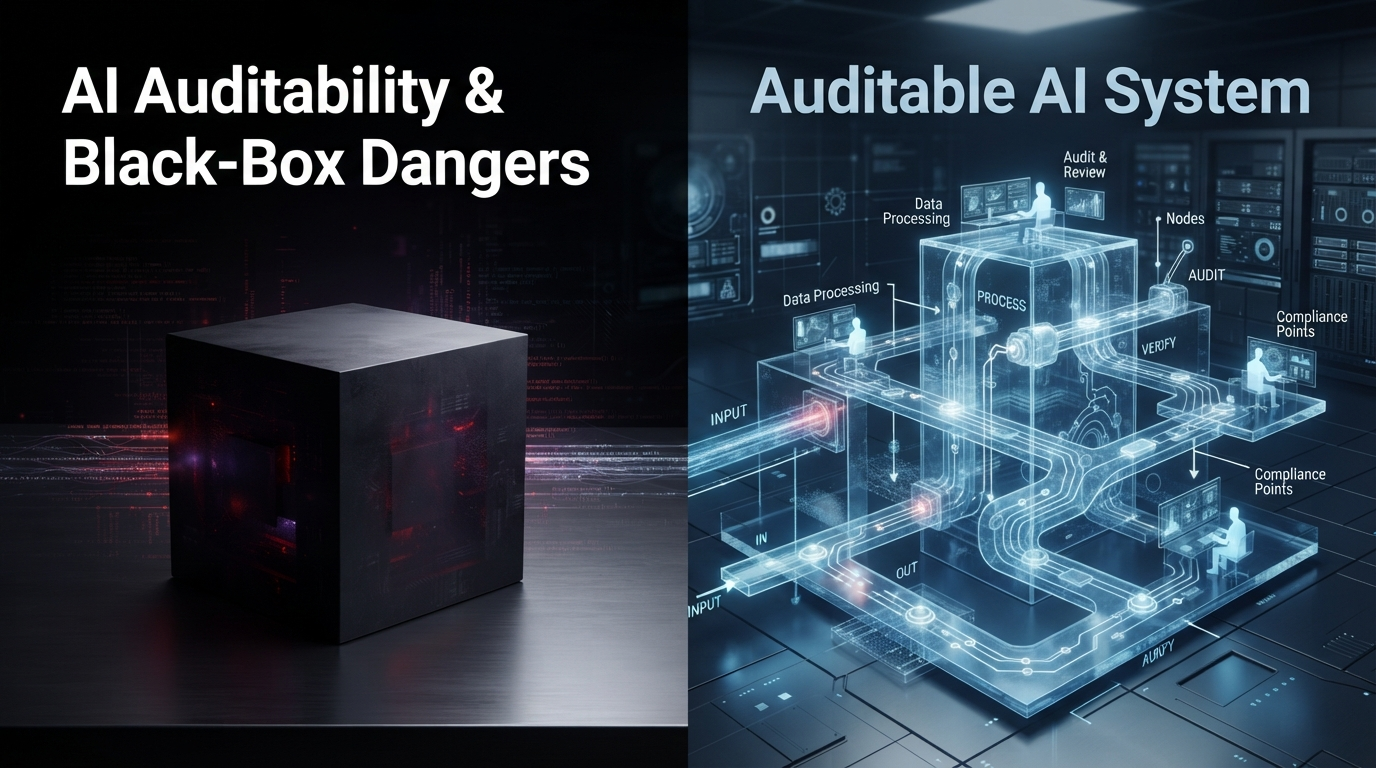
That is why our bespoke AI solutions are designed with auditability from the ground up. We do not treat oversight as something to add later if a client requests it. We build for it from the start. The goal is not to create a black box that users are expected to trust blindly. The goal is to create a system that acts more like a glass box: powerful, efficient, and visible enough to support real accountability.
That design philosophy matters because enterprises do not just need intelligent outputs. They need systems that can withstand scrutiny, adapt to governance requirements, and integrate into the realities of controlled business operations.
Every meaningful step the system takes can be logged and traced. That includes the data involved, the workflow stage, the rules or logic applied, and the resulting output. This traceability creates a clear record of how a result was produced rather than leaving users to infer what happened after the fact.
In practice, this gives businesses something invaluable: evidence. When a question arises, whether from an internal reviewer or an external stakeholder, there is a defensible trail to examine. That makes issue resolution faster, monitoring more effective, and governance far more practical.
For critical decisions, full automation is often neither necessary nor desirable. In many cases, the most effective operating model is one where AI accelerates the work while qualified professionals retain authority over the outcome.
That is why human-in-the-loop review is central to our approach. Key decision points can be configured to require expert sign-off before an action is finalised. This creates a natural checkpoint in the workflow and a clear record of who approved what, when, and under what conditions.
It also strengthens trust across the organisation. Teams are more willing to rely on AI when they know expert judgment has not been removed from the equation. Leaders are more comfortable scaling it when responsibility remains clearly assigned.
A system may collect enormous amounts of data about its own activity, but that is only useful if the information can be understood. We place strong emphasis on reporting that is clear, accessible, and practical for real business review.
That means outputs are not buried in technical jargon or fragmented across disconnected logs. Instead, reporting is structured so that internal audits, compliance reviews, and operational investigations can be performed efficiently. The result is not just transparency in principle, but transparency that can actually be used.
It is easy to frame auditability purely as a defensive measure, something businesses need in order to avoid risk. But that view is too narrow. Auditability is also a strategic advantage.
When AI systems are transparent, businesses can improve them faster. They can see where workflows are working well and where they are breaking down. They can identify recurring exceptions, refine controls, and expand automation more confidently. They can bring legal, compliance, operations, and technical stakeholders into the same conversation because the process is visible enough for all of them to engage with it.
In that sense, auditability supports scale. It allows AI initiatives to move beyond isolated pilots and into sustained operational use. It reduces internal resistance because concerns can be addressed with evidence rather than promises. And it increases resilience because the organisation is not dependent on blind trust in a tool it cannot inspect.
For industries where credibility matters, that becomes a differentiator. Clients, partners, and regulators increasingly expect businesses to be able to explain the systems they rely on. The organisations that can do that well will be in a stronger position than those still treating AI as a sealed mechanism that nobody is allowed to question.
Adopting AI should not require your business to sacrifice control, transparency, or accountability. It should not force compliance teams into uncomfortable compromises or leave operational leaders unable to explain how critical outputs were generated. And it certainly should not mean accepting a system that becomes harder to trust the more important its role becomes.
The right AI solution is not just powerful. It is reviewable. It is governable. It is designed for the realities of your business, especially if that business operates in a regulated or high-stakes environment.
The myth of the black box persists because too many organisations assume opacity is the price of innovation. It is not. With the right design, the right workflow, and the right implementation partner, AI can deliver efficiency without becoming unaccountable.
At CtrlF5 AI, we believe businesses should not have to choose between automation and assurance. With a clear audit trail, meaningful human oversight, and reporting designed for real-world scrutiny, you can harness the value of AI while maintaining the standards your industry demands.
Do not let uncertainty become the reason you delay progress. Choose a solution built for transparency, accountability, and trust from day one.